
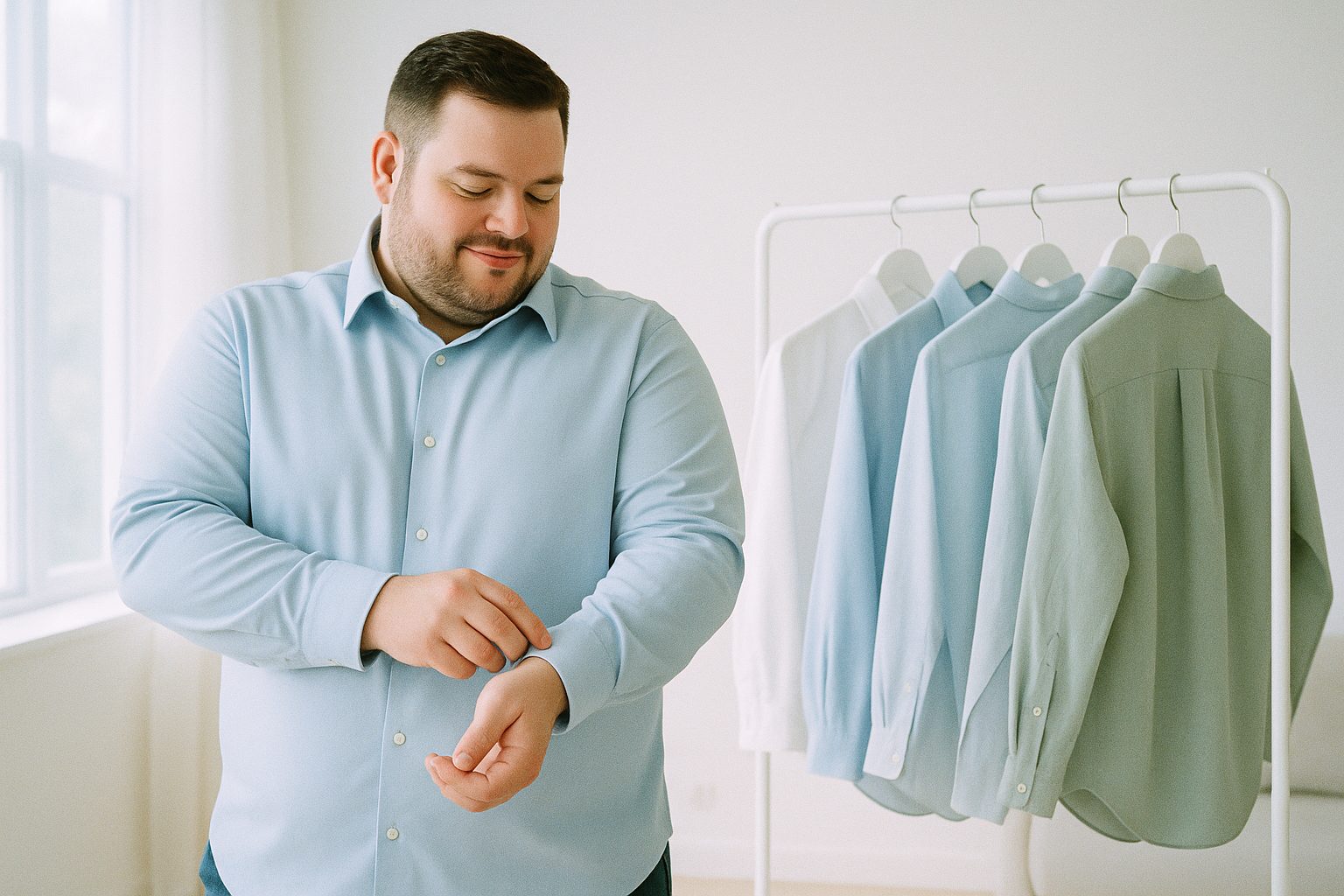


It's not hard to find a shirt that “buttons”. The hard part is finding a shirt that continues to feel comfortable after you've worn it for hours, sat down, reached for something on a shelf, driven a car and maybe even been to a meeting or party.
For large men, a good shirt is rarely about hiding your body. It's about giving space in the right places, choosing a material that works with you, and getting the lengths right so the shirt stays where it should.
Why shirts often fail in large sizes
Many shirts in regular size ranges are “scaled up” as the size increases. The problem is that the body doesn't always grow evenly everywhere. Some have broader shoulders, others more chest, others more stomach or longer arms. When the pattern doesn't take this into account, you end up with buttons that tighten, sleeves that creep up or a shirt that feels bulky.
This is especially noticeable around the stomach and upper arms: If you lack a little extra width in these areas, you'll have less freedom of movement and more folds that sit “awkwardly” when you sit down.
A shirt can be the right size on paper and still be wrong in practice.
Materials that feel good all day long
The material is your foundation. For many large men, comfort means breathability, softness against the skin and enough flexibility for the shirt to follow your movements without constricting.
Cotton is the classic choice, and there's a reason for that. It feels natural, absorbs moisture and works for both everyday and dressy wear. Cotton comes in many qualities and weaves, so two cotton shirts can feel completely different.
Linen is brilliant when it's hot or if you generally get hot in shirts. It's light and airy, but it wrinkles more easily. Many people therefore choose linen for casual outfits, or a linen blend, where you get some of the airiness without the fabric being quite so “alive”.
Polyester and technical blends can be a good choice if you want something that dries quickly, is durable and often more ironable. On the other hand, pure polyester can feel less breathable, especially if you're naturally warm or wearing a shirt under a blazer.
Blends can be a great compromise. Cotton with a little elastane often provides that little extra give that makes a big difference over the chest, shoulders and stomach.
Here's a quick overview when comparing:
| Material | What it feels like | Good for | Pay attention to |
|---|---|---|---|
| Cotton (poplin/oxford) | Soft, classic, breathable | Work, everyday, casual use | Can crease, especially poplin |
| Linen | Very light and cool | Summer, holidays, casual nice | Curls easily, may feel “brittle” at first |
| Polyester/technical | Lightweight, smooth, often quick-drying | Travelling, long days, less ironing | Can get hot, depends on quality |
| Cotton blends (possibly with elastane) | Soft with a little flex | When you want comfort and dimensional stability | Check how much stretch you actually get |
When you hold the shirt in your hand, choose based on your day, not just the look.
- For hot days: Linen or cotton linen
- For office and neat use: Cotton poplin or fine cotton with easy-care finish
- For long days on the go: Cotton blend with a slight stretch
- For those who hate ironing: easy-care or non-iron (but still feel the breathability)
Weaves and textures: poplin, oxford and more “bite”
Two shirts can both be “100% cotton” and still behave completely differently. This is due to the weave and the weight of the fabric.
Poplin is typically smooth and relatively lightweight. It looks nice, fits well under a blazer and often feels cool against the skin. On the other hand, poplin reveals more easily if the shirt is too tight because the fabric doesn't have the same structure to “carry” itself.
Oxford is often a little thicker and more structured. This can be an advantage in larger sizes because the fabric drapes better and doesn't cling to the body as easily. Many also find that oxford holds its shape better throughout the day.
If you want a shirt that's both casual and still looks decent, an oxford is the way to go. comfort fit For many, it's a safe bet.
Fit: regular, comfort and what they mean in practice
Fit is more than whether the shirt is “big enough”. A good shirt for a larger body gives you room without drowning you in fabric. It should hit right at the shoulder seam, be calm across the chest and fall more vertically so there's no tension at the buttons.
Regular fit is the classic straight fit. It works well if you have a relatively even distribution between chest, stomach and shoulders or if you want a more traditional look.
Comfort fit (or relaxed) typically provides extra width at the chest, stomach and upper arms. This is often where large men notice the biggest difference because you get freedom of movement without having to go up too much in size.
It's normal to have to try on two fits in the same “size” before it fits properly.
When trying on the shirt, look out for these signs:
- The buttons pull
- The fabric tightens over your back when you reach forward
- The shoulder seam bites in
- The shirt stands out like a box all the way round
- You'll want to take it off after 20 minutes
Lengths for wide and tall: body, sleeves and collar
Length is an overlooked detail until you've tried a shirt that constantly creeps up. If you're both big and tall, standard lengths can be the main reason why the shirt never feels “right”, even if it's roomy enough.
TALL sizes (often labelled LT and up) is typically about longer body and longer sleeves, not more width. It's useful if you have long arms or if you need to keep your shirt tucked in when you sit down, stand up and move around.
A shirt can be wide enough and still be too short.
The collar is also worth taking seriously. A collar that's too tight feels irritating all day, while a collar that's too loose can make the whole shirt look sloppy, especially if you have a thicker neck or wear a tie.
Small details for big comfort
It's often the little constructions that determine whether a shirt becomes a favourite. Look at cuffs, buttons and armholes, not just colour and pattern.
A double button cuff makes it easier to adjust the wrist, and a slightly deeper armhole can significantly improve mobility for broad shoulders and upper arms. It's also worth checking if the fabric becomes “stiff” across the back when you move your arms.
Here are some details that many will love in large sizes:
- Adjustable cuffs: Better space at the wrist and forearm
- Slight stretch in the fabric: Less resistance at shoulders and stomach
- Easy-care finish: Nicer look with less work
- Good length in the back: The shirt stays down and falls calmer
How to measure yourself and get it right the first time
Size charts can vary from brand to brand, so the best guide is your own measurements. Use a tape measure and measure on a shirt you already feel comfortable in or measure directly on your body with a t-shirt on.
- Measure the neck where the collar is and place a finger under the tape measure.
- Measure your chest at the widest point and make sure the tape measure is horizontal.
- Measure your stomach where you have the most circumference, even if it's below your belly button.
- Measure the sleeve length from the shoulder point down to the wrist, with the arm slightly bent.
If you're in between sizes, go for the larger size and go easy on the fabric. A shirt that's on the tight side rarely becomes more comfortable during the day.
Care and maintenance that keeps the fit
Comfort is also about how the shirt holds up after washing. A good quality shirt can feel great in the store and disappoint after three washes if handled incorrectly.
Wash at the temperature indicated on the shirt and avoid overfilling the drum to allow room for the fabric. Hang the shirt up immediately, preferably on a hanger, and smooth the collar, button placket and cuffs by hand while it is still slightly damp. It makes a bigger difference than many people realise.
If you're going for linen, accept that a little crease is part of the look. It can look casual and well-dressed when the rest of the outfit is playing.
When shopping for plus size shirts: what to look for
It's beneficial to choose ranges where shirts are actually designed for larger bodies and where fit types are clear. Many men get the best results with shirts that are available in both regular and comfort fit, and where there is also the option of extra lengths for tall people.
At Birger's works with large sizes and TALL lengths, so you can find shirts in sizes M to 8XL. M to 8XL and typically LT and upwards in selected models. In practice, this means you can go for the fit that suits your body, instead of “settling” for a size that's just bigger all over.
If you're shopping online, it's worth keeping an eye on the framework of the purchase because it gives you the peace of mind to try at home. Fast delivery in the UK, free shipping over a certain amount and a long right of return makes it easier to order two sizes or two fits and choose the one that fits best. This is often the way to go, especially when switching brands or trying TALL for the first time.
Facebook
WhatsApp
Twitter
LinkedIn
Pinterest
Latest posts

Big & Tall: What does it mean - and what size is right for you?
22 December 2025
No Comments

Everyday style guide: 7 outfits for plus size men
24 December 2025
No Comments
Jeans and chinos in 8XL: How to choose the right model
30 December 2025
No Comments

Shirts for big men: materials, cuts and comfort explained
2. January 2026
No Comments
Underwear for plus sizes: Comfort without compromising on support
8. January 2026
No Comments
