


It’s hard enough to find a jacket that’s suitable for the weather in Denmark. When you also need room across the shoulders, stomach and back, and the sleeves mustn’t end halfway down the forearm, outerwear quickly becomes a frustrating compromise.
Fortunately, you don’t have to choose between “something that zips up” and “something that looks smart”. With just a few specific choices, you can find a jacket or coat that’s both comfortable to wear and gives you a flattering silhouette, whether you wear size M or 8XL, or whether you need number sizes (LT to 6XLT).
Before you choose a model: think about how you’ll use it, not just how it looks
The most important question isn’t whether you’re the “parka sort” or the “coat sort”.
The most important thing is: When will you be using it, how far will you be walking, and how much rain and wind will it need to withstand?
When buying plus-size outerwear, it’s a particularly good idea to start by thinking about your everyday life: your commute, walking the dog, working outdoors, weekends and special occasions. A jacket that’s perfect for the five-minute walk from the car to the office might be completely unsuitable for an hour’s walk in a crosswind.
Here is a short checklist that often makes the choice easier:
- Temperature and wind: Do you tend to run hot, or do you get cold easily?
- Rainfall requirements: Does it need to cope with showers, or does it need to keep you dry on longer trips?
- Activity level: Do you stand still, or do you move around a lot?
- Style requirements: An everyday look, workwear, something smart to wear with a shirt, or something that goes with a suit as well?
Parkas and “long coats”: when the weather calls the shots
A parka, or a longer jacket from the winter range, is the safe choice when cold, wind and rain often strike at the same time. The length makes a bigger difference than many people realise, because it covers more of your body, making it harder for the wind to “get in”.
Parkas are also popular with men who wear larger sizes, as the cut is often more generous. You typically have room for layers, and you can move around without feeling that the jacket is tight across your back.
The collar and hood are particularly worth looking out for. A high collar can help you stay warm without having to wrap yourself up in scarves, and an adjustable hood makes a big difference in windy conditions.
If you’re looking for something parka-style at Hos Birger, you’ll often find it in the rain and wind jackets or functional jackets categories from brands that also stock larger sizes. Some styles are listed with a waterproof rating (e.g. 3,000 mm (on selected jackets), which gives an indication of how much rain it can withstand.
The woollen coat: classic, stylish and surprisingly warm
This woollen coat is for those who want a smarter look without it being too formal. It’s perfect for a day out in town, dinners, work, meetings and any occasion where you want to look well-dressed.
Wool is a natural insulator, and a good coat can feel warmer than it looks. That said, wool isn’t a raincoat. It can cope with a bit of damp and light showers, but in persistent rain, you’ll be better off with a parka or a technical jacket.
With larger sizes, the fit is absolutely crucial: a woollen coat can have some room across the chest and stomach, but it must still drape nicely. Longer styles can be an advantage, as they create a sense of balance in the lines and a “cleaner” look. At Birger's includes, amongst other things, a long woollen coat made from a wool and cashmere blend, which is a good example of the sort of coat many people are looking for on more formal occasions.
One simple detail that often makes a woollen coat more practical: proper inside pockets. When you have room for your mobile, keys and wallet without the coat “pulling”, it feels more comfortable to wear.
Softshell: the versatile solution for changeable weather and outdoor activities
Softshell is for those who want to be able to move freely. It’s lightweight, usually has a bit of stretch, and is often both windproof and reasonably water-repellent, without feeling clammy on the inside.
It’s rarely warm enough on its own in the depths of winter, but for spring and autumn, bike rides, walks in the fresh air and general everyday use, it’s spot on. Many people also use a softshell as a “work jacket” because it allows freedom of movement in the shoulders and arms.
If you’re looking for softshell jackets in larger sizes, you may find that they aren’t always clearly labelled as “softshell” in all online shops. Look for words such as stretchy, breathable, windproof and water-repellent, and for a slightly softer fabric than that of classic rain jackets.
Quick overview: what’s best for you?
It can be useful to see the differences all in one place, especially when you’re trying to find a single jacket that’ll cover as many occasions as possible.
| Type | Best for | Weather | Comfort in larger sizes | Style |
|---|---|---|---|---|
| Parka / longer winter jacket | Cold, windy, everyday use | Good in windy conditions, often good in the rain | Spacious, good for layering, can feel heavy | Casual to smart casual |
| Wool coat | City, work, in good condition | Good in dry, cold conditions; less effective in the rain | May require a more precise fit | Classic and sharp |
| Softshell | Changeable weather, activity | Good in windy conditions, OK in light rain | A great deal of freedom of movement, frequent stretching | Sporty and simple |
Fit in plus sizes: the details that make all the difference
A jacket may be “big enough” on paper and still feel wrong when you try it on. It often comes down to a few key areas: the shoulders, the armholes, the waist and the length.
When trying on outerwear, do so with the clothes you’d realistically be wearing underneath. A thin T-shirt rarely gives an accurate impression in November.
Here are a few simple rules of thumb that usually help:
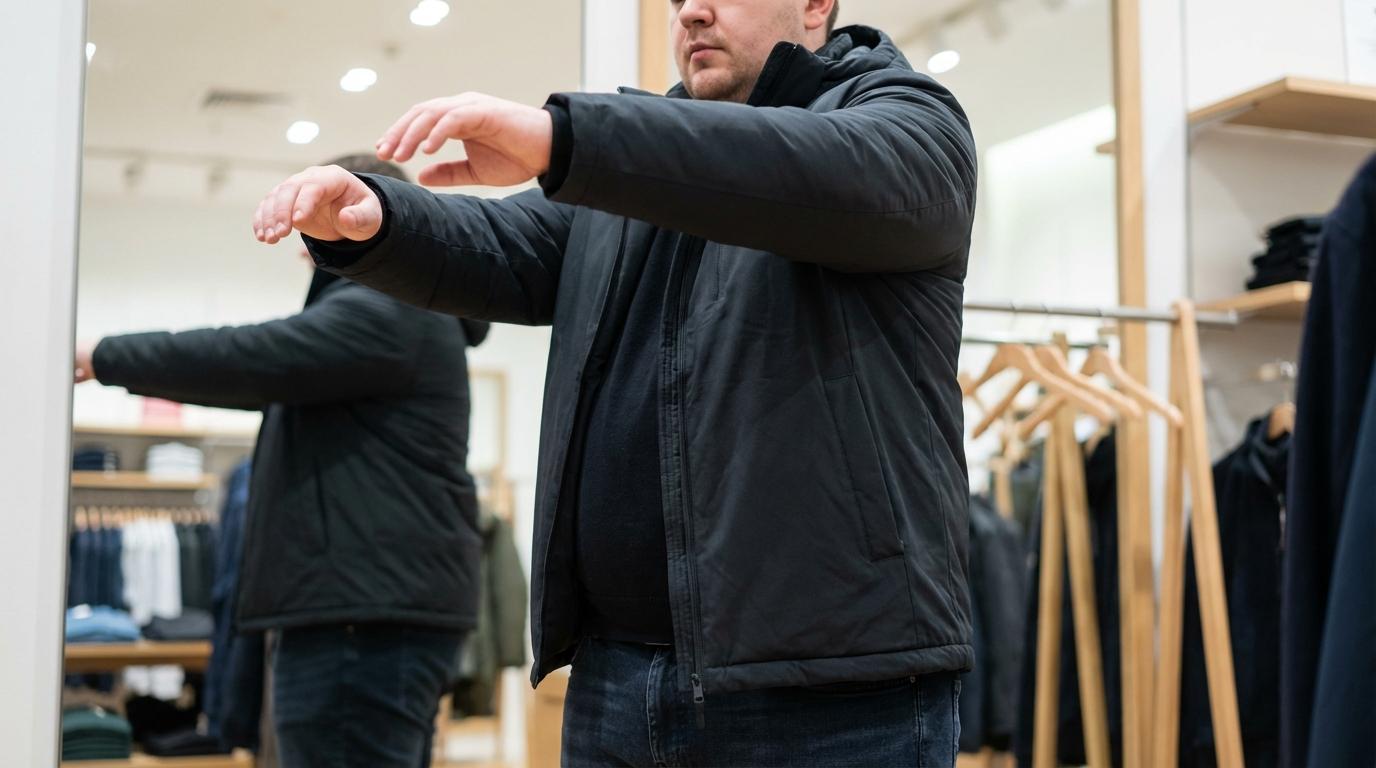
- Shoulders and back: You should be able to stretch your arms out in front of you and up without the jacket feeling tight across your back.
- Sleeve length: The sleeves can be a little longer, so that your wrists are still covered when you move.
- Fitting around the waist and hips: The zip should close without any “bulge” or tightness, and you should be able to sit down without the jacket riding up.
- Length: A slightly longer style often provides more comfort and warmth, especially if you’re tall or simply like to be well covered.
If you often find that jackets are too short, look for sizes marked with numbers. This can be a much better solution than simply going up a size, as it gives you the length you need without making the jacket too baggy.
At Birger, we specialise in sizes ranging from M to 8XL, as well as LT to 6XLT, and this is often where many brands stand out: when they actually have patterns designed for larger body types, rather than simply “scaling them up”.
Materials and maintenance: think six months ahead
It’s tempting to choose what feels lovely in the fitting room. But outerwear gets put through its paces, and in Denmark in particular, it’s a mix of rain, salt, wind and sudden changes in temperature.
Wool coats are best aired, brushed and dry-cleaned as and when required. Parkas and technical jackets can often be washed, but they may lose their surface protection if not cared for properly, and some benefit from being re-waterproofed after a while.
If you bear maintenance in mind, it becomes easier to make realistic choices. A coat that needs dry cleaning might be absolutely perfect for the office and special occasions, but impractical as an “all-purpose jacket”.
Three common shopping mistakes and how to avoid them
Most bad purchases aren’t about taste. They’re about function and fit.
- The sleeves are too short
- Too tight across the back
- Too hot, so it ends up on the hook
If you want to avoid them, test the jacket whilst moving: sit down, stretch your arms out in front of you, lift them up, and try zipping it up and down without looking. If it feels awkward in the shop, it won’t be any better on a windy day.
Here’s how to choose if you only want one “main jacket”
Many people would be happy with just one that can handle most things. This is possible if you choose based on your most common scenario.
Here’s a practical way of looking at it:
- If you walk a lot and are active: A softshell jacket with room for a warm jumper or a lightly insulated waistcoat underneath.
- If you’re feeling cold and spend a lot of time outdoors: A parka or a longer wind and rain jacket with a good collar and hood.
- If you’re often well-dressed: A woollen coat as your main coat, and then a light rain jacket in the car or in your bag for wet days.
At Birger, we don’t stock a huge, uniform range of all types of outerwear all the time, but our focus is precisely on ensuring that what’s on the shelves makes sense in terms of fit and size. And if you shop online, it’s nice to be able to exchange items at your leisure when you need to find just the right length and width.
Small styling touches that create a more striking look
Outerwear in large sizes can certainly be functional. It can still look smart.
A simple colour such as black, navy or khaki is easy to wear and goes well with both jeans and smart trousers. A jacket that falls to mid-thigh can also make you look more “put-together”, as it creates a smoother transition between your top and bottom half.
And these little things make a big difference: a good collar, a zip that glides smoothly, and pockets in just the right place. These are often the things you notice every single day.
When you’re choosing your size for the first time online
If you’re ordering outerwear from an online shop, start by measuring a jacket you already like wearing, and compare it with the measurement chart. Pay particular attention to chest width and back width.
Birger also has a high-street shop in Christiansfeld, whilst many pop in to get advice on fit, plenty also shop online across the country, precisely because it can be difficult to find larger sizes locally. Fast delivery, a generous returns policy and free delivery above a certain amount make it a bit more reassuring to order two sizes and choose the one that fits best around the shoulders and sleeves.
If you like, you can start by thinking about what you need most right now: protection from rain and wind, a smart and classic look, or something light and flexible. That way, you’ll usually get it right on the first or second try.
Facebook
WhatsApp
Twitter
LinkedIn
Pinterest
Latest posts

Big & Tall: What does it mean - and what size is right for you?
22 December 2025
No Comments
Everyday style guide: 7 outfits for plus size men
24 December 2025
No Comments

Jeans and chinos in 8XL: How to choose the right model
30 December 2025
No Comments

Shirts for big men: materials, cuts and comfort explained
2. January 2026
No Comments
Underwear for plus sizes: Comfort without compromising on support
8. January 2026
No Comments
