

Colours have a special power when you want to feel well-dressed without wasting energy on “hiding” yourself. As a plus-size man, it’s rarely about wearing black from head to toe, but about choosing shades that create a sense of calm in the overall look, give a clear silhouette and work well with fits.
Dark colours and earth tones are a good place to start, as they generally create a more cohesive look and are easy to combine with most of what you already have in your wardrobe.
Why dark and earthy colours often flatter a larger figure
When a colour is deep and muted, it “takes up” less visual space. This doesn’t mean you’ll become invisible, but rather that the eye is drawn more to the lines, cut and overall look rather than to individual areas of the body. This is particularly effective if you also choose non-shiny fabrics and clothes that fit well without being too tight.
Earth tones do something else that’s also worth bearing in mind: they add warmth and depth to an outfit without making it look garish or loud. Olive, brown and rust convey a calm confidence that works just as well for everyday wear as it does for smarter occasions.
The dark base colours you can build everything on
Black is the classic choice, but it isn’t always the most interesting option. In fact, many men look more vibrant in navy blue or charcoal grey, whilst still achieving the “unified” effect that dark colours provide.
When choosing dark base colours, think in terms of blocks: the more uniform the colour gradient, the more calm the look. That’s why a dark top and dark trousers often look sharper than a very light top with dark trousers, if the contrast is too stark.
Here are four dark shades that almost always work well as a base:
- Variety
- Navy blue
- Anthracite grey
- Deep burgundy
They can be worn as trousers, jumpers, overshirts, blazers and jackets, and they go well with brown or black shoes, depending on the style.
Earth tones that add style without being overpowering
Earth tones are perfect when you want a splash of colour but still want to keep the look understated. Many plus-size men I like the fact that the outfit isn’t too “loud”, and earth tones strike just the right balance here.
A olive green overshirt Or a sweatshirt can be an easy way to break up the dark base, and a camel or sand-coloured jumper can brighten up the area around the face without making the body look more defined.
A simple rule of thumb: use earth tones as either your mid-tone or your accent colour, and keep the rest as neutral base colours. That way, you’ll achieve both depth and a clear structure.
Tone-on-tone and controlled contrast
Tone-on-tone does not mean that everything has to be the same colour. It means that the colours are similar in intensity and temperature. The result is often a more cohesive, harmonious look.
Controlled contrast is the second strategy. It works well when you “amp up” the contrast around the face (shirt, jumper, scarf) and keep the rest understated. A completely white shirt can certainly work, but many people achieve a softer and more flattering look with off-white, light blue or light grey instead.
If you want to make things easy for yourself, stick to two or three main colours in a single outfit. It feels manageable, and it looks well thought-out.
Materials and surfaces: colours look different in practice
The same colour can look completely different depending on whether the fabric is shiny, thin, heavy or textured. A dark colour in a shiny fabric can actually accentuate your figure, as the light hits it and creates “highlights” on your stomach, chest and thighs.
It’s better to opt for matt finishes, preferably with a bit of texture, especially in outerwear and knitwear. A mottled knit, a subtle weave or a lightly brushed fabric breaks up the surface nicely and gives a more mature look. At the same time, it is often more forgiving in everyday wear, as it doesn’t show every single crease in the garment.
Patterns without noise
Patterns can look lovely, but the size of the pattern makes a big difference. Very large checks or bold, distinct prints can end up “chopping up” the body visually. Small patterns and subtle stripes are generally easier to wear, as they keep the overall look calm.
A vertical micro-stripe on a shirt can create an illusion of length, whilst wide horizontal stripes often have the opposite effect. That doesn’t mean you should never wear them, but it does mean you need to be more careful about the fit, the fabric and the rest of your outfit if you do.
Outfit ideas that work for everyday wear
It’s nice to have inspiration that can be repeated. Here are some “formulas” that often suit plus-size men, as they’re based on dark base colours, earthy tones and a distinct layer upon layer expression.
A few handy rules of thumb can be helpful when you’re standing in front of the mirror:
- Dark base, warm top: darkness jeans or chinos with olive, rust or camel in the top layer or middle layer
- Tone-on-tone in blue: navy blue trousers with a slightly lighter blue shirt and a navy overshirt or blazer
- Grey with a deep accent: anthracite as a base colour, with burgundy in a shirt, jumper or accessories
- Light, neutral in small doses: Crackle white or light grey close to the face, but keep the rest more subdued
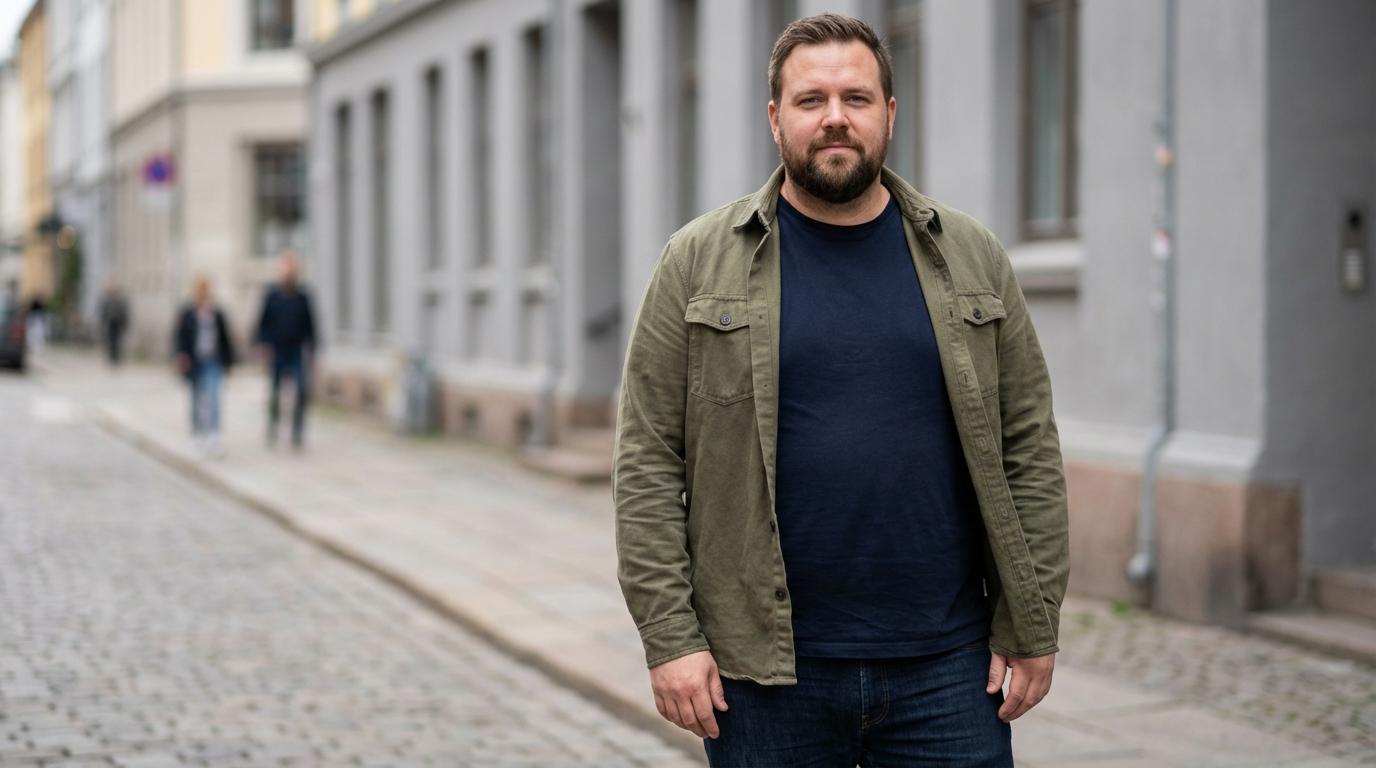
In practice, it can be as simple as dark jeans, a navy T-shirt and an olive-coloured overshirt. Or anthracite chinos, a black jumper and a camel-coloured coat, if you’d prefer a more classic look.
Work and smart casual: when you want to look smart without looking too formal
For work, meetings and events, navy blue and charcoal grey work really well because they convey a sense of calm and quality, whilst still offering more variety than black. If you wear blazer, so look for a style with a flattering shoulder line and a fastening that doesn’t pull across your tummy. The colour helps, but it’s the fit that makes it look sharp.
A simple combination that often works:
- Navy blue blazer
- Light-coloured shirt (white, off-white or light blue)
- Dark trousers (navy, anthracite or black)
- Shoes in brown or black, depending on the belt and style
If you want to add a splash of colour, wear a burgundy or dark green shirt or jumper under your blazer, and keep the rest of your outfit neutral.
Party: depth, texture and one striking detail
When it’s a party, it’s fine to be a bit more daring, but it doesn’t have to involve bold colours. Deep burgundy, dark green and anthracite create a more “evening-like” look, especially if you choose a shirt or jumper with a nice texture and a good drape.
If you usually go for black, why not try swapping just one item: black trousers and a black blazer, but with a burgundy shirt. Or a navy suit with a dark green jumper underneath, if it’s appropriate for the occasion.
Often, a single detail that stands out is enough, with the rest providing a subtle backdrop.
Table: A quick guide to colours and safe combinations
Some combinations are just so easy to repeat. Use the table as a little “cheat sheet” when you want to get dressed without spending too much time thinking about it.
| Purpose | Primary colours | Earth tone/Accent | Tip for the whole picture |
|---|---|---|---|
| Everyday life | Navy or anthracite | Olives | Choose matt fabrics, and keep your shoes and belt in the same shade |
| Smart-casual | Navy + grey | Camel/sand | A light, neutral shade close to the face adds a fresh look without harsh contrast |
| Party/evening | Black or charcoal grey | Bordeaux | Let the colour come through in your shirt or jumper, and keep your trousers and jacket dark |
| Weekend layer | Black + dark denim | Rust/terracotta | Wear a textured mid-layer, such as a jumper or an overshirt |
Accessories that tie the colours together
Accessories is a subtle way to make an outfit look “put-together”. This is particularly true if you stick to dark and earthy colours, where small choices can make a big difference.
Think in terms of proportions: a belt and a watch that suit your build often look more natural than very narrow accessories. And colour-coordination is easy: brown shoes with a brown belt, black shoes with a black belt. The rest can be chosen more freely.
A good way to try out colours is to start with socks, a hat or a scarf in olive, burgundy or dark blue. If you like it, you can incorporate the colour into a shirt, jumper or overshirt next time.
When fit and size complement the colours
Colours are most effective when your clothes fit properly. Very loose-fitting clothes can make your body look bigger, even in dark shades, because of the extra fabric and folds. Conversely, very tight-fitting clothes can also reveal everything you’d rather keep hidden.
If you’re shopping in large sizes, … it’s worth looking for brands and cuts that are designed to fit the body, rather than simply being “scaled up”. At Birger, they specialise in men’s clothing in sizes M to 8XL as well as plus sizes (LT to 6XLT), making it easier to find the right lengths and widths so that the colours have the effect you’re after. And when you shop online, it’s a real advantage to have fast delivery, free delivery above a certain threshold and a generous returns policy, so you can try things on at your leisure at home.
If you’re in any doubt, start with one safe change: swap black for navy blue, or add olive as a mid-layer. It might seem like a small thing, but when you look in the mirror, it often looks like an instant upgrade.
Facebook
WhatsApp
Twitter
LinkedIn
Pinterest
Latest posts

Big & Tall: What does it mean - and what size is right for you?
22 December 2025
No Comments
Everyday style guide: 7 outfits for plus size men
24 December 2025
No Comments

Jeans and chinos in 8XL: How to choose the right model
30 December 2025
No Comments

Shirts for big men: materials, cuts and comfort explained
2. January 2026
No Comments
Underwear for plus sizes: Comfort without compromising on support
8. January 2026
No Comments
