
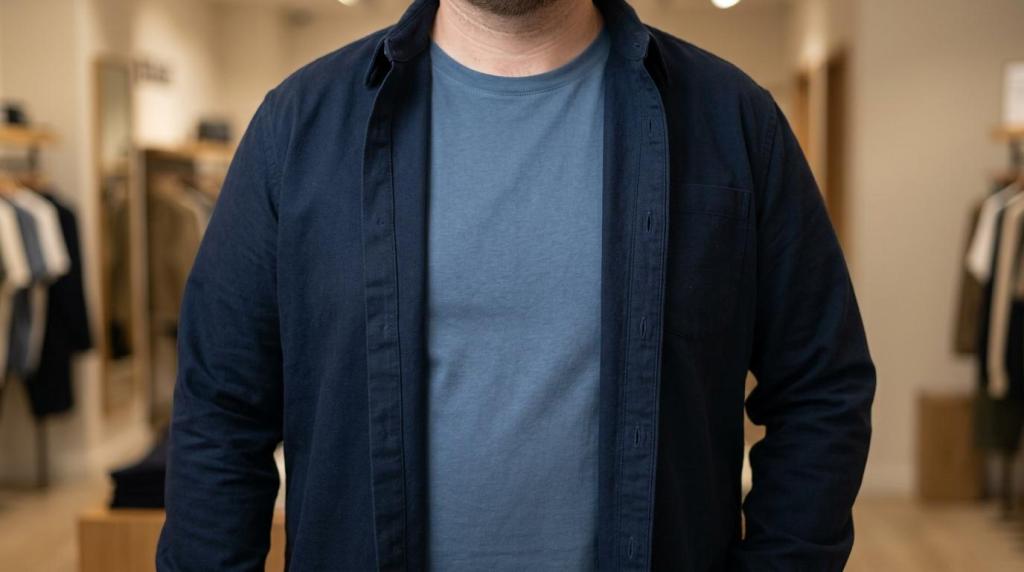


An overshirt can be one of the most versatile items in your wardrobe, especially when you want to dress in layers without feeling swathed up. For many men who wear larger sizes, the challenge isn’t finding yet another layer, but finding a layer that shapes rather than adds bulk.
This is precisely where, overshirtIt’s a versatile piece. It’s somewhere between a shirt and a light jacket, and when fit, when length and material work together, you get a look with texture and a sense of calm. It’s not a look that feels heavy.
Why oversized shirts are a good choice
A good overshirt can really flatter your figure. It creates vertical lines, especially when worn open over a T-shirt or a polo shirt, and it creates a more balanced look. At the same time, it feels less formal than a blazer and less imposing than a jacket.
The most important thing is that it isn’t chosen as a concealing layer. When clothes are too baggy in an attempt to hide the body, the result often makes you look bigger, not smaller. An overshirt should therefore have room in all the right places, but still fit neatly across the shoulders, chest and upper arms.
For men in plus sizes and pine sizes It is often the proportions that determine whether an overshirt works. The width alone is not enough. Sleeve length, the shoulder seam and the length of the body are just as important.
How to choose the right overshirt in plus sizes
The first thing to look at is the shoulders. If the shoulder seam sits too low on the upper arm, the overshirt will quickly look sloppy. A well-fitted shoulder makes even a relaxed-fit style look much sharper.
Next comes the fit around the stomach and chest. The overshirt should fasten without feeling tight, but it mustn’t hang like a tent in front of the body either. The best look is achieved when the fabric falls smoothly rather than pulling or flapping.
Length is also important. An overshirt that ends around the hips or just below is often the most versatile choice. If it’s too long, it can make your upper body look heavier. If it’s too short, you lose the clean line that makes layering look so good.
When you try a overshirt, there are a few simple signs to look out for:
- The shoulders are positioned correctly
- The fabric doesn’t stretch across the chest
- The sleeves end at just the right place
- It falls straight down in front of the body
- There’s room for a T-shirt or a nice jumper underneath
It’s also a good idea to think about how you’ll actually wear it. If you almost always wear a T-shirt underneath, don’t buy a style that only looks good on a bare torso in the fitting room. Try it on with the layer you’ll actually be wearing.
Fabrics for overshirts and layering without bulk
The fabric makes a bigger difference than many people realise. A heavy overshirt in thick flannel or stiff cotton can look great on its own, but it can quickly feel bulky if you also want to wear layers underneath or outerwear ... For a lighter and more flexible look, medium-weight or lightweight fabrics work best.
Particularly in larger sizes, it is an advantage to use fabrics that have a little texture without becoming too stiff. They need to hold their shape, but still drape nicely.
| Material | Why it works | Best for |
|---|---|---|
| Lightweight cotton twill | Provides structure without being too heavy | Everyday life and work |
| Stretch cotton | More freedom of movement and greater comfort | An active everyday life |
| Cotton and flax | Airy and light | Spring and summer |
| Lyocell or soft blends | Falls gently and less stiffly | Casual outfits |
| Fine-knit cotton underneath | Warmth without bulky layers | Chilly days |
If your aim is to reduce bulk, there are some materials and combinations you should be more cautious about. This is particularly true when several thick layers are stacked on top of one another.
- Thick flannel: may cause a feeling of heaviness in the stomach and chest
- Chunky knitwear under an overshirt: often creates too much volume
- Heavy-duty hoodie: takes up a lot of space around the neck and shoulders
- A padded jacket over a heavy overshirt: can make the whole upper body look broader
A simple rule of thumb is this: a thin base layer, one textured layer, and only a top layer on top if the weather calls for it. This formula almost always works.
Colours and vertical lines make a big difference
When talking about layer upon layer, it’s not just about thickness. Colours Contrasts also affect how an outfit is perceived. If the upper body is divided into lots of distinct blocks of colour, the eye is drawn to several different points, and the overall look can appear more compact.
That’s why tone-on-tone is a great option. A dark navy overshirt over a dusty blue T-shirt and dark jeans creates a much more understated look than a light-coloured top, a dark overshirt and sharply contrasting trousers. That doesn’t mean everything has to be dark, but rather that the colours should complement each other.
Open-fronted overshirts are also worth highlighting. When worn open, an overshirt creates two vertical lines down the front of the body. This adds length and a sense of space. Many men find that it is precisely this small detail that makes the biggest difference.
Proportions between the overshirt, T-shirt and trousers
An overshirt works best when the rest of the outfit complements it. If both the top and bottom are very loose-fitting, the overall look can end up looking bulky. A relaxed-fit overshirt looks better paired with jeans or chinos in a clean, straight or slightly tapered fit.
The same applies to the layer underneath. A T-shirt or polo shirt should be smooth and relatively simple. Not too tight, but not so loose that it gathers in folds under the overshirt. When the layer underneath is plain, the overshirt is allowed to be the layer that creates the silhouette.
Here are three useful guidelines to follow when working out proportions:
- Length of the T-shirt: preferably a bit shorter than the overshirt
- The fit of the trousers: Straight legs or slightly tapered legs provide balance
- Details at the neck: Keep the area clean and tidy so that it doesn’t get clumpy
Small tweaks like these can make an outfit look significantly sharper, without you having to change your style.
Three easy outfits featuring overshirts in plus sizes
Styling overshirts well doesn’t have to be complicated. Often, the best solutions are also the simplest. When you keep the base simple and let the overshirt be the standout layer, you achieve a look that appears well thought-out without looking contrived.
- Everyday look: A dark overshirt, a plain T-shirt, dark jeans and clean trainers. It’s simple, foolproof and works in lots of situations.
- Smart-casual style: An overshirt over a polo shirt, chinos in dark sand or navy, and a leather belt. This gives you a bit more structure without looking too formal.
- Cool weather: A thin cotton T-shirt, an overshirt and a longer coat or light jacket. Keep all the layers relatively smooth so that your upper body doesn’t look too bulky.
If you’re tall and wear plus sizes, it’s particularly worth paying attention to the length of the different layers. An overshirt that’s too short on a long torso can easily look wrong, even if the width fits perfectly.
Common mistakes when wearing plus-size overshirts
Many of the mistakes that make a layered look appear bulky are actually quite minor. The problem is simply that they compound each other. An overshirt that’s a bit too heavy, paired with a jumper that’s a bit too thick and a T-shirt that’s a bit too long, can quickly make you look bulkier than you intended.
It is therefore better to focus on a few things that really matter, rather than trying to sort everything out at once.
- Too oversized: rarely creates a lighter look
- Too many thick layers: particularly around the shoulders and neck
- Contrast too high: divides the body into distinct sections
- Top is too long: can make the upper body feel heavy
- Wide-leg trousers paired with a loose-fitting overshirt: upsets the balance
Another classic mistake is to choose an overshirt as a winter jacket, even though it’s actually best worn as a mid-layer. If you want to wear it under a coat or parka, it needs to be light enough for that. If it already feels like a coat in its own right, it becomes difficult to layer anything else over it.
Overshirts to wear under a jacket or coat in large sizes
When the temperature drops, an overshirt is ideal for bridging the gap between your base layer and outerwear. It’s important here that the layers get thicker as you go outwards. A plain T-shirt as the base layer, an overshirt in the middle, and then a jacket or coat that’s roomy enough to accommodate both.
A longer coat can be a good choice because it ties the outfit together. It creates a sense of calm, especially if the overshirt underneath isn’t too bulky. A short, fitted jacket worn over a heavy overshirt rarely achieves the same balance. As By Garment Makers points out in their comparison of wool versus cotton overshirts, wool often provides more warmth and texture, whilst cotton drapes more easily and is therefore easier to wear under coats without feeling bulky.
Always try on your outerwear with the layers you actually plan to wear underneath. It sounds simple, but it’s often forgotten. A jacket that feels great over a T-shirt might fit completely differently with an overshirt underneath.
What to look for when buying an overshirt online
Shopping online can be easy, but overshirts require a bit more attention than a standard T-shirt. Don’t just look at the size. Look at the fit. Is the cut regular, relaxed or oversized? It makes a big difference, especially in larger sizes.
Be sure to read the fabric description carefully as well. A lightweight twill overshirt behaves quite differently from a heavy, brushed fabric. If you want to wear it as part of a layered look without adding bulk, don’t just choose it based on colour or the picture.
It helps to check these points, before adding to your basket:
- Chest measurement: must provide space without becoming baggy
- Shoulder width: more important than many people realise
- Back length: particularly relevant in large quantities
- Sleeve length: Sleeves that are too short can quickly ruin the overall look
- Material and weight: crucial to how heavy the layer feels
At Birger, the focus is precisely on fit, fabric and sizes that take more than just width into account. This is a major advantage when you’re looking for men’s plus-size or tall clothing, where the length and balance need to be just as spot on as the size itself.
If you want to get the most out of an overshirt, keep it simple next time: choose a neutral colour, a plain T-shirt and a pair of dark jeans or chinos. Once you’ve got the basics right, layering suddenly becomes much easier to pull off.
Facebook
WhatsApp
Twitter
LinkedIn
Pinterest
Latest posts

Big & Tall: What does it mean - and what size is right for you?
22 December 2025
No Comments

Everyday style guide: 7 outfits for plus size men
24 December 2025
No Comments

Jeans and chinos in 8XL: How to choose the right model
30 December 2025
No Comments

Shirts for big men: materials, cuts and comfort explained
2. January 2026
No Comments
Underwear for plus sizes: Comfort without compromising on support
8. January 2026
No Comments
